Cook Salary in the Philippines: What to Pay a Household Cook
Cook salary in the Philippines for families: the kasambahay wage floor, pay factors, stay-in vs stay-out, benefits, food money rules and an offer checklist.

Charles writes for Helpers.
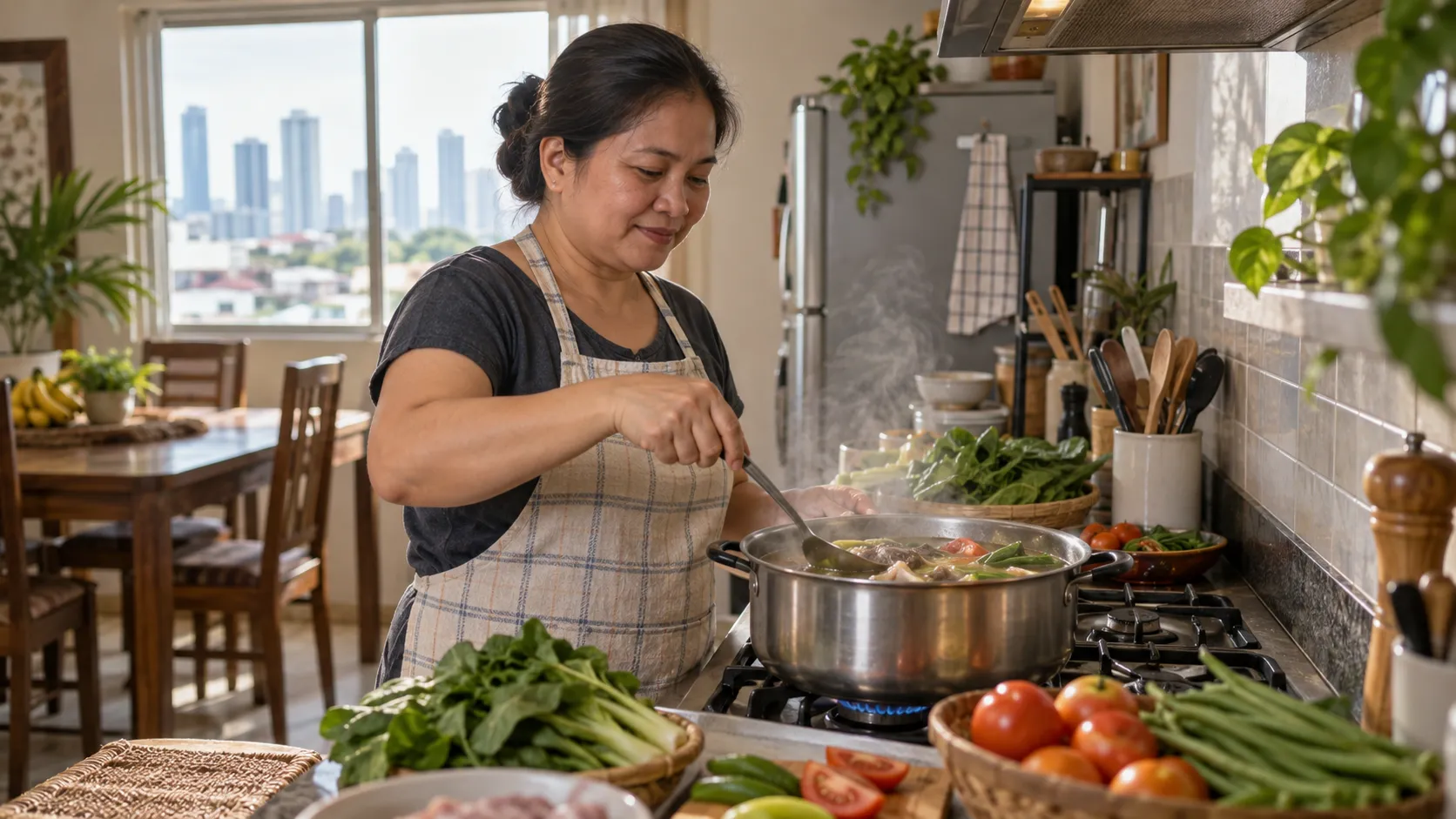
Direct answer: Cook salary in the Philippines for a household cook starts at the kasambahay minimum wage for your region, because a household cook is a domestic worker under RA 10361. That floor is ₱7,800 a month in Metro Manila since 7 February 2026 and ₱7,500 a month in Central Visayas since 14 October 2026, per the NWPC sheet dated 6 October 2026. Skilled cooks usually earn more, and the Helpers planning estimator puts a live-out cook in Metro Manila at about ₱8,400 to ₱14,400 a month. That range is a starting estimate for your own offer, not a wage survey.
Search for "cook salary Philippines" and most results describe restaurant, hotel and canteen kitchens. That is a different job. Your cook plans meals for your family, shops on a budget, cooks three or four times a day in your kitchen, and goes home or goes to a room in your house. The law treats that person as a kasambahay, and that decides the pay floor, the benefits and the paperwork.
This guide shows how to price a household cook: the legal floor, what moves the offer above it, what you owe on top of the salary, and how to handle food money and a trial day. If you still need the duty list, start with the household cook job description and come back here to put a number on it.
Why restaurant cook salaries do not set household pay
Job boards publish averages for "cook" that mostly come from restaurant, hotel and canteen postings. A line cook in a hotel works a station on a shift schedule, usually with a trained team and a kitchen manager. Your cook runs a whole kitchen alone and answers to you and your family's tastes.
The two jobs differ in the ways that matter to a salary offer.
- A household cook is covered by RA 10361 and the regional domestic worker wage order. A restaurant cook is a regular employee under a different set of rules.
- A household cook usually gets meals at work, and a live-in cook gets a room. Those are employer duties under the law, not part of the wage.
- A household cook carries tasks a restaurant splits across people, such as menu planning, marketing, food storage and packing baon.
This guide does not use restaurant averages as household pay. When a cook tells you a restaurant number, treat it as that cook's alternative, which is useful to know when you want to keep them.
The legal floor: kasambahay minimum wage for a cook
Section 4(d) of RA 10361 defines a domestic worker as someone engaged in domestic work within an employment relationship, such as general househelp, nursemaid or yaya, cook, gardener or laundry person. The definition leaves out people who do domestic work only occasionally or sporadically and not on an occupational basis. A cook who works in your home every week is covered.
Regional wage boards set the actual peso floor, and the figures move whenever a board issues a new order. Two examples from the NWPC sheet as of 6 October 2026:
| Region | Monthly minimum for a kasambahay | Wage order | Effective |
|---|---|---|---|
| NCR (Metro Manila) | ₱7,800 | NCR-DW-06 | 7 February 2026 |
| VII (Central Visayas) | ₱7,500 | ROVII-DW-07 | 14 October 2026 |
The NWPC page for the current domestic worker minimum wage links the latest sheet. Some regions list different rates for cities and first-class municipalities than for other municipalities, so look up the place where the cook actually works. Our kasambahay minimum wage guide by region walks through the full table, and you should confirm any figure there against the NWPC page before you sign, since a board can issue a new order at any time.
The Metro Manila order spells out coverage. Wage Order NCR-DW-06 applies to domestic workers on a live-in or live-out arrangement and lists cook by name. It excludes service providers, family drivers and people who work only occasionally. It allows no exemption from the rate. It also says wages are paid in cash at least once a month, with no deductions other than those the law mandates.
Section 6 of the same order lets a household and its worker agree on competency-based pay above the minimum. That is the legal footing for paying a good cook more than the floor.
What goes into a household cook's real monthly cost
The salary is the biggest line, but it is not the whole bill. Build the budget in layers.
- Cash salary, at or above the regional floor.
- A monthly reserve for 13th month pay, which is one-twelfth of the basic salary earned in the year.
- The employer share of SSS, PhilHealth and Pag-IBIG. The cook's own share appears as a deduction on the payslip.
- Meals for the cook, three adequate meals a day under Section 6 of RA 10361.
- A room for a live-in cook, and transport help for a stay-out cook if you agree to it in writing.
- The weekly food budget for the household, which is not salary and should never be mixed with it.
A worked example makes the reserve concrete. Say you hire a live-out cook in Metro Manila at ₱10,000 a month. You earn the same ₱120,000 over twelve months, so the 13th month pay is ₱120,000 divided by 12, which is ₱10,000. Setting aside ₱833.33 each month means December does not surprise you. Your real monthly outlay is about ₱10,833 before SSS, PhilHealth and Pag-IBIG. Use the 13th month pay calculator when the year has a raise or a mid-year start.
Pay factors: what moves a cook's salary above the floor
The wage order is a floor, not a market quote. These are the factors that justify an offer above it, and the ones a cook will raise when you negotiate.
| Factor | What pushes pay up | What keeps it near the floor |
|---|---|---|
| Household size | Six or more people eating, or several meals a day for different schedules | Two adults, one or two meals cooked |
| Menu complexity | Several cuisines, from-scratch cooking, baking, guests on weekends | Everyday Filipino ulam cooked in simple rotation |
| Dietary needs | Diabetic, low-sodium, allergy-safe or toddler meals cooked separately | No special diets |
| Marketing and budgeting | Cook plans the week, shops palengke and supermarket, tracks the budget and receipts | You or a helper shops, and the cook only cooks |
| Hours and schedule | Early baon, late dinners, weekend meals, split shifts | Fixed daytime hours, set rest day |
| Stay-in or stay-out | See the next section | See the next section |
| Experience | Years in a similar household, references you can call | New to household cooking |
| Training | TESDA Cookery NC II, food handling and hygiene training | No certificate, but a strong trial day |
| Extra duties | Light kitchen and dining area cleaning, pet food, packed meals for relatives | Cooking only |
| Location | Makati, BGC, Taguig and other high-cost areas | Provincial cities |
Read the table as a negotiation map, not a formula. A cook in a four-person home who plans no menus and does no marketing is a smaller job than a cook who feeds eight people and runs the pantry.
Menu complexity and dietary needs
A cook who prepares two Filipino ulam a day is a different hire than one who keeps a diabetic grandparent on a controlled menu and a toddler on separate meals. Write the diet instructions down before you set the salary. If a doctor has given limits, give the cook the written limits and ask them to follow the list without substituting ingredients.
Marketing and budgeting duties
Marketing is part of the job in most households. A cook who plans a week, shops two or three times, compares prices at the palengke and returns receipts and change is doing the work of a household purchaser as well as a cook. That deserves a higher rate than a cook who is handed ingredients.
Cook and helper salary when one person does both
Families often ask for a "cook and helper" in one hire. That is a bigger job than cooking alone. Price it from the cook's higher range and add for the extra hours, not from the cleaner's. The Helpers salary guide uses the same estimator for both roles, and in Metro Manila it shows an all-around helper at about ₱7,800 to ₱13,200 against ₱8,400 to ₱14,400 for a cook. If the person also watches children, it is a third job. Our domestic helper job description shows what an all-around post covers.
Stay-in or stay-out: how it changes the offer
Live-in does not mean cheaper. Section 6 of RA 10361 requires the employer to provide at least three adequate meals a day and safe, humane sleeping arrangements, and it forbids withdrawing those as punishment. Those are household duties, so a live-in cook still receives at least the full regional minimum in cash.
What does change is the shape of the day.
- A stay-out cook pays for commute and may need help with transport, especially for early baon or late dinners. The longer the commute, the harder it is to hire for a 6am start.
- A live-in cook lives where they work, so the line between working time and rest time blurs. Section 20 gives a domestic worker an aggregate daily rest period of eight hours, and Section 21 gives at least 24 consecutive hours of rest each week. Agree the rest day in writing.
- A live-in cook needs a room that is private and safe, a place to keep their own things, and access to outside communication during free time.
Offer the same cash salary for both arrangements and adjust only for the real cost differences, such as a transport allowance for the stay-out cook. Explain each adjustment in the contract.
How to benchmark when there is no official market rate
The government publishes a legal floor, but we did not find an official market rate for household cooks. Anyone quoting one rate for "private cook salary Metro Manila" is giving you an estimate. Here is how to build your own number.
- Start from the wage order for your region and write down its number and effective date.
- Use the Helpers salary guide and its estimator for a planning range by city. Its figures blend legal floors with Helpers' own role assumptions, and the page says plainly that they are not a survey.
- Browse cooks in your city and read the expected salary on the profiles. Three or four profiles show you where the real asking range sits.
- Ask for a reference from a household, not a restaurant, and ask what that household paid.
- Add the cost items from the earlier section and check that you can sustain the total for a year, not just a month.
If you are still unsure, offer a number inside the planning range, explain what is included, and let the candidate respond. A cook who counters with a figure and a reason is easier to hire than one who accepts anything.
Benefits you owe on top of the salary
Treat these as part of the offer, not extras. They come from RA 10361 and are the same for a cook as for any kasambahay.
13th month pay. Section 25 entitles a kasambahay to 13th month pay as provided by law. PD 851 sets the payment date at no later than 24 December each year. Our kasambahay 13th month pay guide shows the computation, including a part-year start.
SSS, PhilHealth and Pag-IBIG. Under Section 30, a kasambahay who has served at least one month is covered by all three. The employer shoulders the premiums, except that a worker earning ₱5,000 or more a month pays a proportionate share. Every regional floor on the NWPC sheet is above that line, so expect to split contributions. See the SSS contribution guide and the PhilHealth and Pag-IBIG guide for the current rates.
Rest day and leave. Section 21 gives 24 consecutive hours of weekly rest, agreed in writing. Section 29 gives five days of paid service incentive leave after one year of service. Unused leave does not carry over and cannot be converted to cash. The rest day, leave and holiday pay guide covers the details.
Written contract and payslip. Section 11 requires a written contract before work starts, in a language both parties understand, and a signed copy for the worker. It must state duties, compensation, authorized deductions, hours and extra pay, rest days, board and lodging, and termination. Section 26 requires a payslip every payday, kept for three years. The contract template and the payslip template guide save time.
Health certificate. Section 12 lets the employer require a medical or health certificate before the contract, along with barangay and police clearance and NBI clearance. The same section says the employer or agency pays for these. For a cook who handles your family's food, a health certificate is a reasonable request.
Handling food money and receipts
Food money is where trust is built or lost. The cook is spending your money every week, so set the rules before the first shop.
- Keep the weekly food budget separate from salary. Salary is the cook's money. The budget is the household's money. Never pay one from the other.
- Hand over the budget in advance, in cash or on an e-wallet. Do not ask the cook to pay from their own pocket and wait for a refund, since that turns your grocery bill into an informal loan.
- Ask for the receipt or a written list of what was bought and what each item cost. Many palengke stalls give no receipt, so a notebook entry with item, price and date is a fair standard. Ask the cook to photograph the list each week.
- Count the cook's own meals in the budget. Section 6 requires three adequate meals a day, and a cook who eats leftover rice because the budget did not stretch is a warning sign.
- Review the week together for ten minutes. Compare spending to what ended up on the table, and adjust the budget when prices move.
- Do not deduct breakage or kitchen losses from the salary. Section 14 makes it unlawful to require a deposit from which deductions are made for loss or damage to household tools, materials, furniture and equipment. Section 25 allows only deductions the law mandates unless the worker consents in writing, so treat a deduction as a last resort you write into the contract.
Section 23 covers one more case. If you ask the cook to prepare food at a relative's house for an event, the worker must agree, and the work outside your household earns an additional payment of not less than the existing minimum wage rate of a domestic worker. The original employer cannot charge the other household for it.
The paid trial cooking day
A paid trial day is the best check on whether an offer matches the skill. It costs one day's pay and saves months of a bad fit.
- Agree the daily rate before the day starts, for example your monthly offer divided by 26 working days, and write it down.
- Give the cook your real weekly budget, your real menu rotation and the one food nobody in the house eats.
- Ask them to plan two meals, shop for them, cook lunch and dinner, and hand back receipts and change.
- Watch four things: whether the food tastes right for your family, whether the budget held, whether the kitchen was clean at the end, and whether they asked questions instead of guessing.
- Pay the day in cash before they leave.
- If you hire, sign the written contract before the first regular workday.
A TESDA certificate tells you something, but not everything. The Cookery NC II training regulations are packaged from the Tourism Sector for hotel and restaurant work, with a nominal training duration of 316 hours. The competencies cover stocks, sauces and soups, salads, meat and seafood dishes, and desserts. A cook who holds it has real training and may expect more pay. It does not test whether they can feed six people on a fixed budget, so the trial day still decides.
Salary-offer checklist
Run through this list before you send the number.
- I looked up the wage order for the place where the cook will work and wrote down its number and effective date.
- My offer is at or above that floor in cash, with no deduction for meals or lodging.
- I listed the duties and what is not included, such as laundry, childcare and cooking for a business.
- I set the hours, the split-shift break and a weekly rest day of 24 consecutive hours, in writing.
- I decided between stay-in and stay-out and wrote down any transport help.
- I priced the extras: marketing, special diets, guests and weekend meals.
- I added the 13th month reserve, SSS, PhilHealth and Pag-IBIG, meals and a room if live-in.
- I planned the food budget, the receipt routine and the weekly review.
- I arranged a paid trial day and agreed the daily rate.
- I prepared the written contract and a payslip for every payday.
Frequently Asked Questions
Is a household cook covered by the kasambahay minimum wage?
Yes. Section 4(d) of RA 10361 lists cook next to general househelp, yaya, gardener and laundry person, and Wage Order NCR-DW-06 names cook in its coverage list for live-in and live-out workers. A cook who works for one household on a regular basis is a kasambahay. Family drivers and people who work only occasionally are the ones left out.
How much should I pay a private cook in Metro Manila?
The floor is ₱7,800 a month in NCR from 7 February 2026. Above that, the Helpers planning estimator shows about ₱8,400 to ₱14,400 a month for a live-out cook in Metro Manila and ₱9,100 to ₱15,600 in Makati, BGC and Taguig. These are planning ranges, not a wage survey. Set your offer from the duties, hours and the cook's skill, then test it against candidates.
Does a live-in cook get a lower salary because of free meals and a room?
No. Section 6 of RA 10361 makes three adequate meals a day and a safe, humane place to sleep the employer's duty. They are not wages, so they do not reduce the cash salary or count toward the minimum wage. Do not deduct for them unless the law or a written agreement the worker consented to allows it.
Do I pay 13th month pay, SSS, PhilHealth and Pag-IBIG for a cook?
Yes. Section 25 of RA 10361 gives a kasambahay 13th month pay, due on or before 24 December. Section 30 covers the cook under SSS, PhilHealth and Pag-IBIG after one month of service. The employer pays the premiums, except that a worker earning ₱5,000 or more a month pays a proportionate share.
Should I pay for a trial cooking day?
Yes. Pay the day in cash at the end of it, at a daily rate you agree on beforehand. A trial day on your real menu and budget shows more than an interview does. If you hire the cook, sign the written contract before the first regular workday.
A practical next step for families
Pick your region's wage floor, write the duty list, and set an offer inside your planning range. Then browse cooks near you, compare a few profiles, and run a paid trial day with your top choice. Review your whole budget in the Helpers salary guide, read more in the family guides, and when you are ready to message candidates, create a family account.
Sources checked for this guide
- Republic Act No. 10361: Domestic Workers Act (Batas Kasambahay) (The Lawphil Project; accessed 2026-10-16)
- Current monthly minimum wage for domestic workers (as of October 6, 2026) (National Wages and Productivity Commission; accessed 2026-10-16)
- Current monthly minimum wage for domestic workers (National Wages and Productivity Commission; accessed 2026-10-16)
- Wage Order No. NCR-DW-06: Minimum Wage Rate Increase for Domestic Workers in NCR (Regional Tripartite Wages and Productivity Board - NCR; accessed 2026-10-16)
- Presidential Decree No. 851: 13th-Month Pay (The Lawphil Project; accessed 2026-10-16)
- Training Regulations: Cookery NC II, Tourism Sector (Hotel and Restaurant) (Technical Education and Skills Development Authority; accessed 2026-10-16)
- Kasambahay salary in the Philippines (salary guide and estimator) (Helpers; accessed 2026-10-16)
Last editorial review: 2026-10-16. Sources and regulated claims can change; confirm the current position before acting.
Related Guides

How to hire a verified yaya in Metro Manila
How families in Manila, Makati, and Taguig hire a yaya in 2026: the ₱7,800 NCR floor, a brief you can copy, and the checks that come before a contract.

Nanny vs Babysitter vs Yaya in the Philippines: Which to Hire
Nanny, babysitter, yaya or all-around helper? Compare duties, pay structure and kasambahay law under RA 10361 to choose the right childcare for your family.
Caregiver Interview Questions Philippines: 31 to Ask
31 caregiver interview questions for Filipino families, with good answers, a paid trial shift, red flags, reference checks, and the legal basics.