Singapore Domestic Helper Salary: Guide for Filipino Workers
Salary rules for Filipino domestic helpers in Singapore: the SGD 650 DMW floor, pay timing, rest days, deductions, no placement fee, and contract checks.

Charles writes for Helpers.
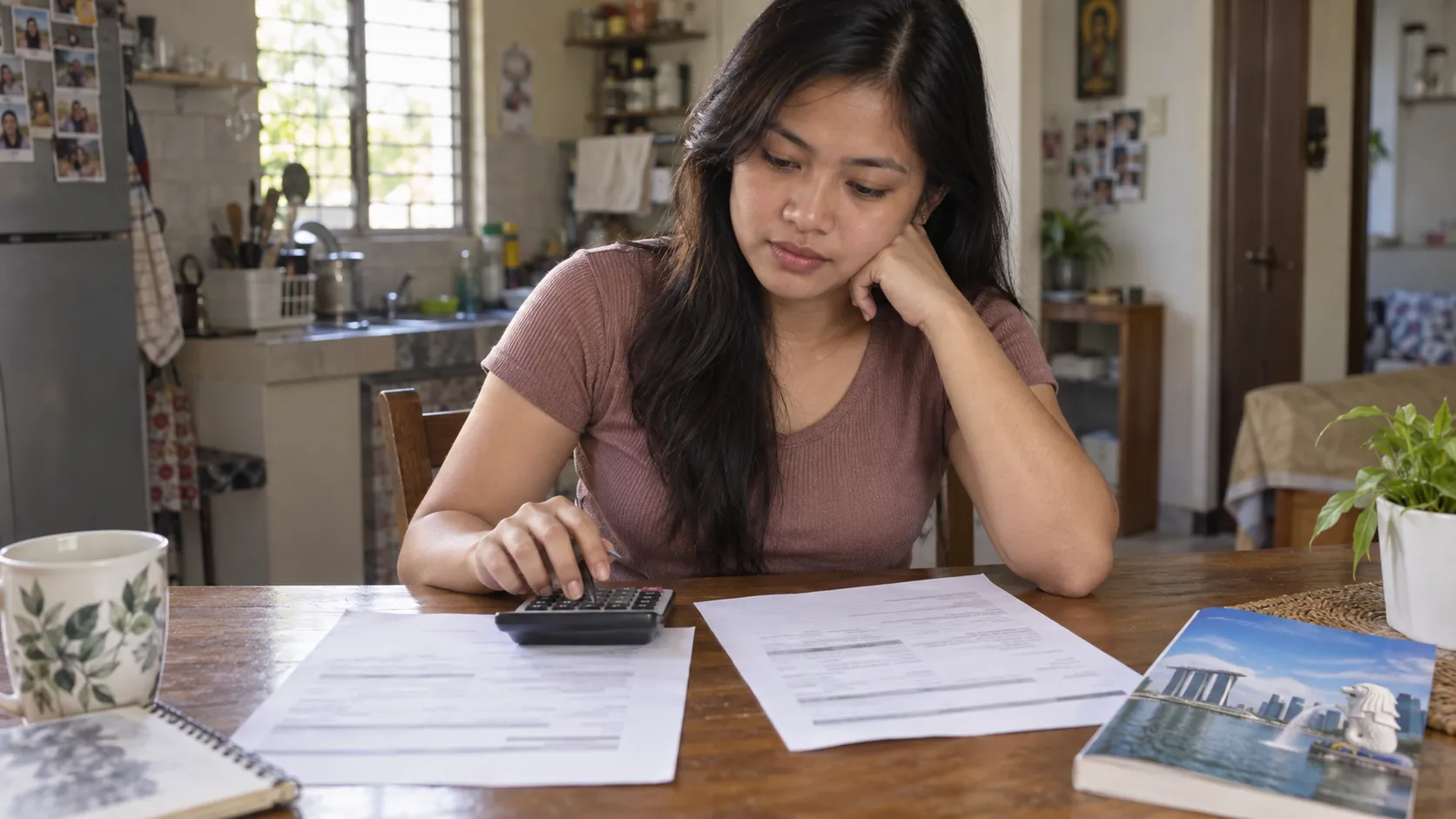
Direct answer: Singapore sets no minimum wage for migrant domestic workers, so your salary is the amount you and the employer agree and the employer declares to the Ministry of Manpower (MOM). The Philippines does set a floor. The Migrant Workers Office (MWO) Singapore states SGD 650 (US$500) a month for new Filipino contracts processed from 21 October 2025. Your pay is due within 7 days after each salary period, and you should never pay a placement fee.
If you are a Filipino domestic worker thinking about a job in Singapore, the offer on your phone has three numbers that matter: the monthly salary, the number of rest days, and what the employer plans to deduct. This guide explains each one using MOM and Philippine government sources, so you can check an offer before you sign.
It covers helpers deployed from the Philippines. It does not rank agencies and it does not quote market averages, because neither MOM nor the MWO publishes a typical salary range. Instead you will find how to compare offers yourself.
Is there a minimum salary for a domestic helper in Singapore?
Under Singapore law, no. MOM says it does not prescribe minimum wages for any worker in Singapore, local or foreign, and leaves wage levels to labour market supply and demand (MOM FAQ on minimum wage for foreign workers). What MOM does require is that the employer pays at least the salary declared to MOM in the Work Permit application (MOM salary guidelines).
That means two numbers should match: the salary in your contract and the salary the employer declared to MOM. If they differ, ask why before you travel.
What is the Philippine minimum salary for Singapore?
The Philippines sets its own floor for Filipino household service workers (HSWs) deployed abroad. The Department of Migrant Workers (DMW) historically used US$400 a month. The MWO Singapore now states that the minimum is SGD 650 (US$500) a month, up from US$400, under DMW Advisory No. 25, series of 2025. It applies to new employment contracts processed on or after 21 October 2025, including renewed contracts for returning or vacationing workers, and it is "without prejudice to higher wages" (MWO Singapore help article).
The MWO's standard employment contract for agency hires prints the same line in the salary clause: "Minimum Monthly Salary is SGD 650" (MWO Standard Employment Contract).
Three cautions:
- The text of the advisory itself was not available when this guide was written. The DMW lists its issuances on its advisories page. Confirm the current figure with the MWO before you accept a number that looks low.
- News reports in 2025 disagreed on how strictly the US$500 rate would be enforced across host countries. For Singapore, the MWO article and contract template are the official statements to rely on.
- The floor is the lowest figure the MWO will process, not a fair price. Experience, childcare, elder care, and extra duties can justify more.
Where do salary ranges come from, and how do you compare offers?
Neither MOM nor the MWO publishes an average or typical salary for Filipino helpers, so any number you see in a Facebook post, agency ad, or video is an opinion, not an official figure. Use it as a starting question, not as proof.
You can compare offers without a market number. Put each offer into the same grid:
| Element | What to ask | Why it matters |
|---|---|---|
| Monthly salary | The exact SGD amount, declared to MOM | Pay cannot be lower than the declared amount |
| Pay date | The day of the month, and bank or cash | MOM requires payment within 7 days after the salary period ends |
| Rest days | How many a month and which day | MOM requires a weekly rest day and at least one a month that cannot be paid out |
| Rest day pay | The rate if you agree to work that day | MOM requires at least one day's salary |
| Food | Three meals a day, or an allowance | The MWO contract requires adequate meals on top of salary |
| Housing | Own room or shared, and with whom | The MWO contract requires suitable accommodation with reasonable privacy |
| Medical | Who pays for treatment | The MWO contract says the employer pays |
| Home leave | Days and ticket, in writing | The MWO template has blanks for this; MWO recommends 15 days every two years |
| Duties | Household size, children, elders, pets | Heavier duties are a fair reason to ask for more |
| Fees | Anything you must pay | Filipino HSWs should pay no placement fee |
Then compare the totals that you control: salary, rest days, home leave, and room. A slightly higher salary with no rest days and no home leave is a worse offer than it looks.
When and how must you be paid?
MOM's rules for migrant domestic workers (MDWs) are specific:
- The salary period cannot be longer than one month.
- The employer must pay no later than 7 days after the last day of the salary period.
- The salary must not be lower than the amount declared to MOM.
- The employer should pay by bank transfer to your own account, not a joint account with the employer. If you ask for bank transfer, the employer must pay that way.
- For cash, you and the employer must both sign each payment record.
- Since 1 January 2019, employers cannot keep your salary or any other money of yours, even if you ask them to. They also cannot keep your bank book or card.
These points come from the MOM salary guidelines, last updated 14 March 2024. Open a bank account in your name and keep a photo of each cash record.
What are the rest day rules?
MOM says you are entitled to one rest day per week, and you and the employer must agree which day it is. You can take it as one full day or as two half days (MOM rest day rules, last updated 16 January 2026).
The MWO contract template goes further on the number: it says you are entitled to four rest days per month on a day agreed by both sides, plus at least 8 hours of continuous rest each day. Read both together. The week rule comes from MOM, and the contract can promise more but not less than what Singapore requires.
Can you be paid instead of taking a rest day?
Partly. If you agree to work on a rest day, MOM requires the employer to compensate you with at least one day's salary, separate from your basic salary. Since 1 January 2023, the employer must also make sure you get at least one rest day each month that cannot be compensated away (MOM employer newsletter, September 2023).
MOM's example divides a monthly salary of S$650 by 26 days to get S$25 per day. If you agree to work 2 rest days in a month, that adds S$50 to the S$650 basic pay, for S$700 that month. The worker should be paid this on top of the basic salary, and the employer declares the basic salary without the rest day payment.
Notice the word "agree." An employer who says "you have no rest days, I will pay you extra" is breaking the monthly rule. A rest day you work should be your choice, not a condition of the job. Write down which days you worked and what you were paid.
What deductions are allowed?
Less than many job offers suggest. MOM's September 2023 newsletter tells employers not to deduct medical expenses, flight tickets, penalties for performance issues, or damage to household equipment from an MDW's salary.
MOM's page on salary deductions, last updated 16 December 2024, adds these rules for work permit holders:
- An employer may not deduct for work pass renewal, security bonds, medical insurance, repatriation, compulsory training, medical fees, or levy payments.
- An employer may not make deductions as a condition of employment.
- Reducing salary or making a new or larger deduction needs your written consent and notice to MOM.
- Total deductions cannot exceed 50 percent of the salary payable in one salary period, with exceptions such as absence and recovery of advances or loans.
Do not sign a paper that says "other deductions may apply." Ask what each deduction is, how much, and how many months it lasts. For a Filipino worker, the Philippine side is stricter, as the next section shows.
Do Filipino helpers pay a placement fee?
No. The MWO Singapore states that Filipino domestic workers are exempt from placement fees under Republic Act 10022 and DMW rules, and that "any agreement requiring the worker to pay a placement fee is void and unenforceable." It also states that deductions to recover recruitment, placement, or training costs are prohibited, including arrangements called loans or advances. Workers who are charged fees or have wages deducted should report to the MWO (MWO help article).
The agency-hire contract package adds an employer undertaking: placement fees charged by Singapore employment agencies and administrative costs must not be charged to or recovered from the worker through salary deductions, loans, or any indirect means (MWO Standard Employment Contract).
You may see a different rule in Singapore. MOM says Singapore employment agencies may collect no more than one month of a worker's salary for each year of service, capped at two months (MOM employment agency fee FAQ). That is a general cap on what agencies may collect from foreign workers. It does not turn a fee into something a Filipino HSW should pay. If anyone asks you for money, stop and ask the MWO first.
Check the Philippine recruiter too. The DMW lists licensed agencies and verification tools on its workers page. Our guide to checking a DMW-licensed recruitment agency walks through the steps.
How does the MWO verify your contract?
The MWO Singapore, which sits inside the Philippine Embassy compound at 20 Nassim Road, Singapore 258395, is the Philippine government office that handles Filipino workers in Singapore (Philippine Embassy page). For a new hire through an agency, the MWO describes this process:
- The employer gets MOM in-principle approval to hire a domestic worker.
- The employer uses a MOM-licensed Singapore employment agency, which works with a DMW-licensed Philippine recruitment agency.
- The employer holds a "Know Your Employer" video conference with you before the contract is final.
- The contract follows the DMW standard contract. The Singapore agency submits it to the MWO for verification, and the Philippine agency processes it in the Philippines.
- You complete a medical exam and the required pre-departure seminars, then receive an Overseas Employment Certificate (OEC) or OFW Pass.
- On arrival, MOM issues the Work Permit.
The MWO also says replacing a verified contract with another one without MWO authorization is not allowed, and any substantial change to the contract is void unless both sides agree, a witness signs, and the MWO approves. So if the employer hands you a second contract at the airport or after arrival with a lower salary, do not sign it. Contact the MWO. Our guide to OWWA membership for household service workers explains the welfare coverage that is part of deployment.
Contact details published by the MWO: telephone +65 6040 6506 and an emergency hotline +65 9113 6552. Confirm the numbers on the MWO website before you rely on them.
Which scams target Filipino helpers going to Singapore?
The MWO says to report anyone who charges fees or takes wages. Beyond that, these patterns are common warning signs, and each one conflicts with the process above:
- A recruiter asks for a "processing," "training," "reservation," or "medical" fee before you have a verified contract.
- You are asked to pay into a personal account instead of getting an official receipt.
- The salary in the chat is higher than the salary in the contract, with a promise to "make up the difference later."
- The recruiter says you can skip the DMW steps, the OEC, or the MWO verification.
- The employer will not do a video call or give an address.
- You are told the job is in Singapore but the household or work will be different on arrival.
- Someone says the contract will be signed after you land.
One red flag deserves a question. Two or more deserve a stop and a call to the MWO. A real job survives checking.
Pre-departure checklist
Before you leave, confirm each of these in writing:
- The monthly salary is at least SGD 650 and matches what the employer declared to MOM.
- The pay date and method are in the contract, with a plan for a bank account in your own name.
- Rest days are written as a number per month, with the day agreed.
- You understand how rest day work is paid: at least one day's salary, only if you agree.
- The contract lists no deductions beyond what MOM allows, and none for recruitment or training.
- You have paid no placement fee, and you hold receipts for anything else you paid.
- Food, housing, medical care, home leave, and notice terms are in the contract.
- The Philippine recruiter and the Singapore agency are verified on official lists.
- The MWO has verified the contract, and you have your OEC or OFW Pass.
- You keep your passport, Work Permit, and a signed copy of the contract.
- You have saved the MWO telephone number and hotline in your phone.
- A trusted person at home has copies of your documents and the employer's address.
Singapore support lines for domestic workers appeared in MOM's September 2023 newsletter, including the FAST helpline (1800 339 4357) and the Centre for Domestic Employees (1800 225 5233). Check that they are still current.
What if the salary is not paid as promised?
Start with records: your contract, bank statements, signed cash records, and a dated note of what is missing. Ask the employer in writing when the unpaid amount will arrive. If the payment is late or short, contact the MWO, MOM, or the agency that placed you. MOM treats the salary payment rules as work permit conditions, so a missed payment is a compliance issue, not a favour.
Do not give up your passport, Work Permit, or contract copy to anyone for safekeeping. The MWO contract says the passport and work permit must remain with you at all times.
For a helper-side view of the cost families face, our Singapore domestic helper cost guide shows how salary sits next to the levy and other costs. Before you travel, read our guide to OEC requirements for domestic workers. For more worker-side guides, see the helper guides.
Frequently Asked Questions
How much is the salary of a domestic helper in Singapore?
Singapore does not set a minimum wage for migrant domestic workers, so the amount is whatever you and the employer agree and the employer declares to MOM. For Filipino workers, the Migrant Workers Office Singapore states a Philippine minimum of SGD 650 (US$500) a month for new contracts processed from 21 October 2025.
Is there a minimum salary for a Filipino domestic worker in Singapore?
Not under Singapore law, but yes under Philippine rules. The Department of Migrant Workers sets the floor for Filipino household service workers, and the MWO Singapore contract template prints SGD 650 per month as the minimum. Higher pay is allowed and common to negotiate.
Can my employer make me work on my rest day?
Only if you agree. If you agree, MOM requires the employer to pay at least one day of salary for that day, on top of your basic salary. Since 1 January 2023, at least one rest day a month cannot be traded for money.
What salary deductions are allowed for a domestic helper in Singapore?
The employer cannot deduct your medical costs, flight tickets, work permit costs, levy, insurance, or penalties for performance or household damage. Any deduction needs your written consent and MOM notice, cannot exceed 50 percent of one salary period, and cannot recover recruitment fees from a Filipino worker.
Do Filipino domestic workers pay a placement fee to work in Singapore?
No. The MWO Singapore states that Filipino household service workers are exempt from placement fees, that any agreement requiring one is void, and that recovering recruitment or training costs through deductions, loans, or advances is prohibited. Report any fee demand to the MWO.
A practical next step for Filipino helpers
Before you accept a Singapore offer, put the salary, rest days, and fees in one grid and compare them with the MWO contract. Then create or update your Helpers profile with your true experience, childcare or elder care skills, and the roles you want.
Sources checked for this guide
- Paying the salary of a foreign domestic worker (Singapore Ministry of Manpower; accessed 2026-10-16)
- Rest days, health and well-being for migrant domestic workers (Singapore Ministry of Manpower; accessed 2026-10-16)
- Is there a prescribed minimum wage for foreign workers in Singapore? (Singapore Ministry of Manpower; accessed 2026-10-16)
- Salary deductions (Singapore Ministry of Manpower; accessed 2026-10-16)
- Why it matters to pay your MDW her salary on time and in full (employer newsletter, September 2023) (Singapore Ministry of Manpower; accessed 2026-10-16)
- How will foreign workers know the amount that they are expected to pay the Singapore EA? (Singapore Ministry of Manpower; accessed 2026-10-16)
- Hiring Filipino Domestic Workers in Singapore (Migrant Workers Office Singapore, Department of Migrant Workers; accessed 2026-10-16)
- Standard Employment Contract (agency hire) for Filipino household service workers in Singapore (Migrant Workers Office Singapore, Department of Migrant Workers; accessed 2026-10-16)
- MWO-Singapore (Philippine Embassy in Singapore; accessed 2026-10-16)
- Services for workers: verification of recruitment agencies and job orders (Department of Migrant Workers, Philippines; accessed 2026-10-16)
- DMW advisories, 2025 (Department of Migrant Workers, Philippines; accessed 2026-10-16)
Last editorial review: 2026-10-16. Sources and regulated claims can change; confirm the current position before acting.
Related Guides

Tools and Equipment in Housekeeping: Uses, Safety, and Storage
A categorised list of housekeeping tools, equipment, cleaning agents, and PPE with their uses, safe handling, bleach dilution, and storage for Filipino learners.
NBI Clearance for Helpers: Requirements, Fee, and Hits
How a Filipino helper applies for an NBI clearance online, what to bring, what a hit means, how validity and renewal work, and how to avoid fixers.

OWWA Membership for Household Service Workers: Fees and Benefits
OWWA membership for Filipino domestic workers abroad: the US$25 fee, validity, who pays, how to register or renew online, and the benefits you can claim.