Tools and Equipment in Housekeeping: Uses, Safety, and Storage
A categorised list of housekeeping tools, equipment, cleaning agents, and PPE with their uses, safe handling, bleach dilution, and storage for Filipino learners.

Charles writes for Helpers.
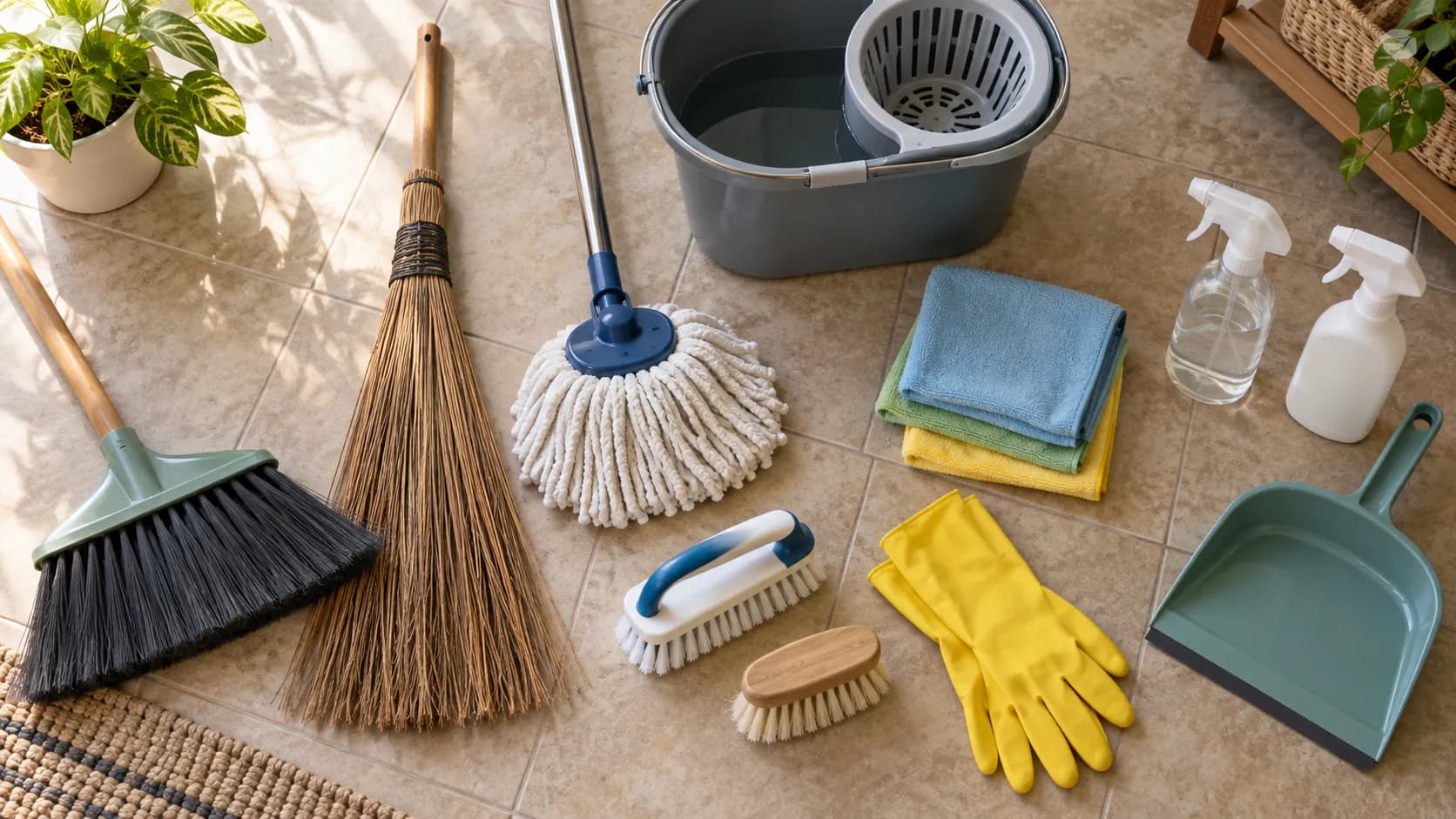
Direct answer: Housekeeping tools and equipment fall into five groups: hand tools (brooms, mops, buckets, brushes, cloths, squeegee), powered equipment (vacuum cleaner, floor polisher, steam cleaner, hotel trolley), cleaning agents (detergent, disinfectant, bleach, glass cleaner, degreaser), protective gear (gloves, mask, apron, closed shoes), and laundry items. For each item, learn what it cleans, how to handle it safely, and where it is stored. Never mix bleach with ammonia or acids.
Ask five Filipino housekeepers what is in their kit and you get five answers. A hotel room attendant pushes a trolley with linen and spray bottles. A condo cleaner carries a mop, bucket, and squeegee. A kasambahay in a family home may use a walis tambo, a rag, and whatever the family bought at the grocery.
The names change, but the job is the same. Pick the right tool for the surface, use the right amount of chemical, protect your body, and put everything back clean. This guide lists the common tools and equipment, what each is for, and how to handle and store it. It also covers chemical safety, because that is where most injuries happen.
Tools versus equipment versus supplies
Housekeeping gear falls into three groups, and TESDA keeps them separate.
- Tools are hand-held and manual. Examples are a broom, mop, brush, or squeegee.
- Equipment is larger or powered. Examples are a vacuum cleaner, floor polisher, or housekeeping trolley.
- Supplies and materials get used up. Examples are detergent, bleach, sponges, and cloths.
The TESDA Housekeeping NC II training regulations include a recommended list of tools, equipment, and materials for a training class of 25. It names mops, brushes, brooms, buckets, dust pans, squeegees, spray bottles, lint-free cloths, and a mop squeezer as tools. Its equipment list includes a trolley, a toilet caddy, a carpet sweeper, a wet and dry vacuum cleaner, and an electric polisher.
That list is for training centres. Your workplace will have its own kit, and a private home will have far less. Use the lists below to learn what each item does, not as a shopping checklist.
Cleaning tools and their uses
| Tool | Use | Safe handling | Care and storage |
|---|---|---|---|
| Walis tambo (soft broom) | Sweeping dry dust and light dirt from floors | Sweep toward a pile, not into the air. Wet the floor lightly for fine dust. | Hang it bristles up or off the floor so the bristles stay straight. |
| Walis tingting (coconut-rib broom) | Sweeping yards, balconies, and rough outdoor surfaces | Do not use it on polished or wood floors, because the stiff ribs scratch. | Keep it dry and off the ground. Replace it when the ribs break. |
| Dust pan | Collecting swept dirt | Hold it flat to the floor. Empty it into a covered bin. | Rinse and dry after use. |
| Mop and mop squeezer | Wet cleaning of hard floors | Wring well on hard floors so water does not pool. Place a caution sign. | Rinse in clean water, wring, and hang to dry head up. A wet mop left in a bucket smells and spreads germs. |
| Bucket | Carrying water and cleaning solution | Fill it only halfway so you can lift it. Label it if it holds a chemical. | Empty, rinse, and store upside down. |
| Scrub brush and toilet brush | Scrubbing tiles, grout, sinks, and toilets | Use a separate brush for toilets and never use it for the kitchen. | Rinse after use. Keep toilet brushes away from other tools. |
| Sponge and scouring pad | Dishes, kitchen counters, and stuck-on dirt | Check the surface first, because a rough pad scratches stainless steel and glass. | Rinse, squeeze, and let it dry. Replace when it smells or breaks apart. |
| Microfiber and lint-free cloth | Dusting, wiping glass, mirrors, and counters | Fold the cloth into quarters and use a clean side for each area. | Wash after use, without fabric softener, which coats the fibres. |
| Squeegee | Pulling water off glass, mirrors, and shower walls | Work top to bottom and wipe the blade between strokes. | Hang it off the floor. A bent blade leaves streaks. |
| Anti-static duster | Dusting shelves, blinds, and electronics | Dust high to low. Do not use it on wet surfaces. | Shake it outdoors and wash as the label says. |
| Spray bottle | Applying diluted cleaner | Label it with the product name and dilution. | Rinse before refilling with a different product. |
| Step ladder | Reaching high shelves, light fittings, and curtain rails | Open it fully, lock the braces, and keep three points of contact. | Store folded, dry, and out of walkways. |
TESDA's Housekeeping NC II lists brooms, dust pans, mops, buckets, brushes, a squeegee, and cleaning cloths in its range of cleaning supplies. Walis tambo and walis tingting are not named in the regulation, but they are the brooms most Filipino households use, so know both.
Colour-code your cloths and brushes if your workplace allows it. One colour for toilets, another for the kitchen, a third for dusting. This stops you from wiping a counter with the cloth you used on the toilet seat.
Cleaning equipment and its uses
| Equipment | Use | Safe handling | Care and storage |
|---|---|---|---|
| Vacuum cleaner (dry or wet and dry) | Carpets, rugs, upholstery, and hard floors | Check the cord and plug first. Never vacuum a spill unless it is a wet and dry model. | Empty the bag or bin before it is full, clean the filter, and wind the cord loosely. |
| Carpet sweeper | Quick pickup of crumbs and lint on carpet | Push slowly in straight lines. | Empty the dust tray after each use. |
| Electric floor polisher | Buffing and polishing hard floors | Do not use it unless you were trained on it. Keep the cord behind you and the floor dry. | Clean the pad after use and store it off the floor. |
| Steam cleaner | Loosening grease and grime on tile, grout, and sealed surfaces | Steam burns. Keep hands clear, never point it at people, and check that the surface can take heat. | Empty the tank, let it cool, and descale it as the maker directs. |
| Housekeeping trolley or cart | Carrying linen, supplies, and a bin through a hotel | Load heavy items low. Push it, do not pull it. Keep chemicals on a closed shelf. | Restock at the end of each shift, wipe it down, and park it in its set place. |
| Toilet caddy | Carrying toilet cleaners and brushes in one place | Keep it separate from kitchen and glass supplies. | Wash it weekly and dry it. |
| Washing machine, dryer, iron, and ironing board | Laundry | Do not overload the machine. Unplug the iron when you leave the board. | Clean the lint filter every load. |
The same TESDA list includes a trolley, cart, toilet caddy, carpet sweeper, wet and dry vacuum, electric polisher, washers, a dryer, a flat iron, an ironing board, and steam pressers. Steam cleaners are not in the regulation. If your employer owns one, ask for a demonstration before you switch it on.
Before you use any powered machine, check three things. The cord and plug should be undamaged. The floor around you should be dry. And you should know where the off switch is. Report a damaged cord to your supervisor or employer. Do not tape it and carry on.
Cleaning agents and chemicals
A cleaning agent removes dirt. A disinfectant kills germs on a surface that is already clean. Many people use one when they need the other, which wastes product and raises risk.
| Product | Use | Safe handling | Storage |
|---|---|---|---|
| All-purpose cleaner or detergent | Daily cleaning of counters, floors, and walls | Dilute as the label says. More product does not clean better and leaves a film. | Original container, closed. |
| Disinfectant or sanitiser | Toilets, door handles, switches, and kitchen surfaces after cleaning | Follow the label for contact time, which is how long the surface must stay wet. | Original container, closed. |
| Bleach (sodium hypochlorite) | Disinfecting hard surfaces and whitening white cotton | Dilute it, wear gloves, open a window, and never mix it. | Cool, shaded, and capped. It weakens in sunlight and heat. |
| Glass cleaner | Mirrors, windows, and glass tables | Spray the cloth, not the glass, and keep it off wood. | Original bottle. |
| Degreaser | Cooker hoods, stove tops, and greasy kitchen tiles | Wear gloves and check the surface. Some degreasers damage paint and aluminium. | Away from heat and food. |
| Toilet bowl cleaner (acid-based) | Limescale and stains in toilets | Never use it with bleach. Flush before using any other product. | Away from other chemicals. |
| Stain remover and fabric softener | Laundry | Test on a hidden corner. | Closed, off the floor. |
TESDA's recommended list for Housekeeping NC II training includes cleaning detergent, sanitising agents, chlorine bleach, all-purpose detergent, stain removing agents, fabric softener, and toilet disinfectant. Glass cleaner and degreaser are not named, but you will meet both on the job.
Under the Domestic Work NC II training regulations, the unit on cleaning the living room, dining room, bedroom, bathroom, and kitchen lists chemical compatibility, measuring and mixing sanitising agents, and storing cleaning materials as required knowledge. In plain terms, TESDA expects you to know which products can sit next to each other and which cannot.
How to dilute bleach for surfaces
Bleach strength differs by brand and country, so read the percentage of sodium hypochlorite on your bottle. Do not copy a ratio from a friend or a video without checking your own label.
The WHO guidance on cleaning and disinfecting surfaces gives a formula: divide the percentage on the label by the percentage you want, then subtract 1. The answer is the number of parts of water for each part of bleach.
| Your label says | You want | Parts of water per 1 part bleach | Rough example |
|---|---|---|---|
| 5% | 0.1% (1000 ppm), general surfaces | 49 | About 20 mL of bleach in 1 litre of water |
| 5% | 0.5% (5000 ppm), large body-fluid spills | 9 | About 100 mL of bleach in 1 litre of water |
WHO recommends 0.1% for general surface disinfection in non-health-care settings such as homes, offices, and restaurants. It reserves 0.5% for blood and body fluid spills larger than about 10 mL. It also says to clean the surface with soap or detergent first, because bleach is quickly used up by dirt.
The rest of WHO's handling advice for hypochlorite is plain.
- Clean the surface with detergent and water before you disinfect.
- Prepare the solution in a well-ventilated area.
- Mix a fresh batch each day. If you must keep it, store it in a covered, opaque container away from direct sunlight.
- Apply with a cloth soaked in the solution. WHO does not recommend routinely spraying or fogging disinfectant indoors.
- Wait for the contact time on the label before you wipe or rinse.
High concentrations corrode metal and irritate skin and airways. Do not make the mix stronger because a surface looks dirty. Scrub first.
Chemical safety rules
The CDC bleach guidance says never to mix household bleach, or any disinfectant, with other cleaners or disinfectants. The mix can release vapours that are dangerous to breathe. Two mixes cause most accidents.
- Bleach and ammonia. The Washington State Department of Health says the mix produces toxic chloramines. Symptoms include coughing, nausea, shortness of breath, watery eyes, chest pain, and wheezing.
- Bleach and acids. The same department says chlorine bleach mixed with an acid gives off chlorine gas. It lists some glass and window cleaners, vinegar, toilet bowl cleaners, drain cleaners, and dishwasher detergents among acid products. In a Filipino bathroom, add muriatic acid to that list.
WHO's surface guidance gives the same warning in short form. Avoid combining disinfectants, because the mixes irritate the airways and can release potentially fatal gases, especially with hypochlorite.
Follow these rules every shift.
- Read the label before you open the bottle. Look for the product name, the hazard symbols, and the directions for dilution.
- Use one product at a time. If you must switch from toilet cleaner to bleach, flush and rinse the bowl first.
- Keep every chemical in its original container. If you pour a dilution into a spray bottle, label the bottle with the product name and date. Never use a drink bottle, because someone will drink from it.
- Open a window or turn on the fan. Do not use strong products in a closed bathroom.
- Keep chemicals away from children, pets, and food. Store them high or locked, never under the sink next to the rice or cooking oil.
- Pour carefully. Put the water in the bucket first, then add the chemical, so it does not splash.
- Stop if you smell something sharp. Leave the room, get fresh air, and tell your employer or supervisor. If anyone has trouble breathing, call emergency services or go to the nearest hospital and bring the bottles so staff can see the ingredients.
Never leave a hazard unmarked in a public area. TESDA's unit on cleaning public areas, facilities, and equipment says to barricade the work area or place warning signs to reduce risk to colleagues and customers.
Protective equipment for cleaning
| Item | What it protects | Notes |
|---|---|---|
| Rubber gloves | Hands from chemicals, water, and germs | Keep one pair for toilets and another for the kitchen. Rinse before you take them off. |
| Face mask | Nose and mouth from dust and fumes | Wear it for dusty jobs and when pouring strong products. |
| Goggles | Eyes from splashes | Wear them when pouring concentrate or cleaning above your head. |
| Apron or overalls | Clothes and skin | A waterproof apron helps when mopping or scrubbing. |
| Closed, non-slip shoes | Feet from spills and sharp objects | Wet floors cause falls. Slippers do not grip. |
| Headwear | Hair from dust and chemicals | Common in hotels and food areas. |
WHO's minimum protective gear for people preparing and using disinfectants in non-health-care settings is rubber gloves, an impermeable apron, and closed shoes. It adds that eye protection and a mask may also be needed if there is a splash risk. TESDA's Housekeeping NC II training list includes overalls, jackets, aprons, goggles, masks, headwear, and waterproof clothing and footwear.
A household helper often works without any of this. If you are asked to handle bleach or toilet acid with bare hands, you are allowed to ask for gloves. Put the request politely and say why. A family that has not thought about it usually agrees. If you are a kasambahay, add it to the list of things you ask about when you agree the work.
Laundry and kitchen items
Laundry and kitchen work uses its own set of items, and mixing them up spreads germs.
Laundry. Use a sorting basket, a laundry basket, a washing machine or a basin, detergent, fabric softener where wanted, stain remover, an iron, and an ironing board. Sort whites, colours, and delicates. Read garment care labels and never mix bleach with a coloured load. Clean the lint filter in the dryer after every load. Unplug the iron and let it cool before you store it.
Kitchen. Use separate sponges, cloths, and brushes for dishes, counters, and the sink. Wash dishes with detergent and hot water, then rinse. Do not use bleach or degreaser near food that is uncovered. Rinse any surface that touches food. Keep the cutting boards clean and let them dry upright.
Do not share between zones. A cloth that cleaned the toilet never goes near the kitchen, even if you wash it. Mark each cloth and brush with a colour so the next person knows its job.
Care and storage of cleaning tools
Clean tools do a better job and last longer. A routine is simple.
- Rinse after every use. Wash buckets, brushes, and spray bottles with clean water.
- Dry before storing. Wet mops, sponges, and cloths grow mould and smell.
- Hang, do not stack. Hang brooms and mops head up, off the floor, so the bristles keep their shape.
- Check for damage. Look for frayed cords, cracked handles, and worn brushes. Report them. TESDA's performance criteria say defects are identified and reported, and equipment is stored in its designated area, ready for reuse.
- Store chemicals separately. TESDA's criteria say chemicals are stored and controlled in line with health and safety requirements. Keep bleach apart from acids and ammonia products, with the lids on.
- Give every item a place. A labelled shelf or hook makes missing items obvious.
The 5S housekeeping method guide shows how to set this up. Sort out tools you do not need, give each remaining tool a fixed spot, clean as you go, write the standard down, and keep checking it. The routine takes about ten minutes at the end of a shift and saves much more time the next day.
Tools and the TESDA competencies
TESDA's Housekeeping NC II covers the hotel and accommodation setting. Its competencies include cleaning and preparing rooms, cleaning public areas, facilities, and equipment, laundering linen, and following workplace and safety practices. In the room-cleaning unit, you set up trolleys, select supplies, and clean and store the equipment after use. In the public-areas unit, you select equipment suited to the cleaning to be done, check that it is clean and in safe working condition, and prepare chemicals as the manufacturer and safety rules direct.
Domestic Work NC II covers the household setting. Its cleaning unit covers cleaning surfaces and floors, furnishings, beds, bathrooms, and kitchens, and sanitising rooms. Read how Housekeeping NC II and Domestic Work NC II differ before you choose a course.
To find a registered school, use the TESDA training provider search. Training regulations are revised from time to time, so check the version you will be assessed on.
For a sense of the duties that go with these tools, read the housekeeper job description for the Philippines and the cleaner job description.
Frequently Asked Questions
What are the basic tools and equipment in housekeeping?
Basic tools are brooms, dust pans, mops, buckets, brushes, sponges, cleaning cloths, a squeegee, spray bottles, and gloves. Equipment is the larger or powered gear: a vacuum cleaner, floor polisher, carpet sweeper, steam cleaner, and the housekeeping trolley used in hotels.
What is the difference between cleaning tools and cleaning equipment?
Tools are mostly hand-held and manual, such as a broom or scrub brush. Equipment is larger, often powered, and needs training, a safe power source, and maintenance, such as a vacuum cleaner or electric floor polisher. TESDA lists tools and equipment separately in its Housekeeping NC II training regulations.
How do you dilute bleach for cleaning surfaces?
WHO guidance for non-health-care settings is 0.1% chlorine (1000 ppm) for general surface disinfection, after cleaning with detergent. Divide the percentage on your bleach label by 0.1 and subtract 1 to get the parts of water per part of bleach. Read your label, mix fresh daily, and never add other cleaners.
Which cleaning chemicals should never be mixed?
Never mix bleach with ammonia, because the mix produces toxic chloramine gas. Never mix bleach with acids such as toilet bowl cleaner, drain cleaner, muriatic acid, or vinegar, because the mix releases chlorine gas. As a rule, use one product at a time and rinse the surface between products.
How should you store cleaning tools and chemicals?
Wash and dry tools after use, hang mops and brooms off the floor, and keep equipment in a set place. Keep chemicals in their original labelled containers, closed, in a ventilated spot away from children, food, heat, and direct sunlight. Never put a chemical in a drink bottle.
A practical next step for helpers
Make your own one-page tool and chemical checklist from the tables above. Write down each tool you can use, each product you have handled, and the safety rules you follow. Add it to your work history so a family or employer can see what you know. Then create your helper profile on Helpers, and browse more helper guides to prepare for your next job.
Sources checked for this guide
- Housekeeping NC II training regulations (Technical Education and Skills Development Authority; accessed 2026-10-16)
- Domestic Work NC II training regulations (Technical Education and Skills Development Authority; accessed 2026-10-16)
- TESDA registered training providers for Housekeeping NC II (Technical Education and Skills Development Authority; accessed 2026-10-16)
- Cleaning and disinfection of environmental surfaces in the context of COVID-19: interim guidance (World Health Organization; accessed 2026-10-16)
- Bleach mixing dangers (Washington State Department of Health; accessed 2026-10-16)
- Cleaning and disinfecting with bleach (US Centers for Disease Control and Prevention; accessed 2026-10-16)
Last editorial review: 2026-10-16. Sources and regulated claims can change; confirm the current position before acting.
Related Guides

NBI Clearance for Helpers: Requirements, Fee, and Hits
How a Filipino helper applies for an NBI clearance online, what to bring, what a hit means, how validity and renewal work, and how to avoid fixers.

OWWA Membership for Household Service Workers: Fees and Benefits
OWWA membership for Filipino domestic workers abroad: the US$25 fee, validity, who pays, how to register or renew online, and the benefits you can claim.

OEC Requirements for Domestic Workers: OFW Pass Guide
OEC requirements for Filipino household service workers in 2026: OFW Travel Pass vs OEC, validity, exemption, who pays fees, airport checks, and scams.